




- Experiences
-

- Experiences
-
- Experiences
-

- Experiences
-
- Experiences
-
- Unique Experiences
- Unique Experiences

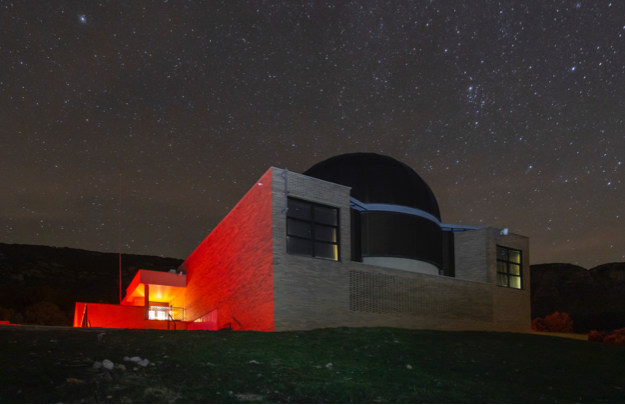
Camí del Coll d'Ares, s/n25691 Àger, Lleida
View on google mapsSegueix-nos
Enllaços als perfils del Parc Astronòmic a Facebook, X, Instagram i YouTube.

WHAT ARE YOU GOING TO SEARCH?
The Eclipse Horizon: How to Prepare in April for the Big Event on 12 August
- 22 April, 2026
- AstronomiaAstronomy
By Salvador J. Ribas
The most eagerly awaited astronomical event is fast approaching. When preparing to observe a solar eclipse, the first step is to ensure that we are within the path of totality and to know whether the eclipse will be total or partial. In the case of the upcoming event on 12 August, however, simply choosing a location within the path of totality will not be enough: there is one crucial factor that will make all the difference – the horizon.
A special and fleeting eclipse
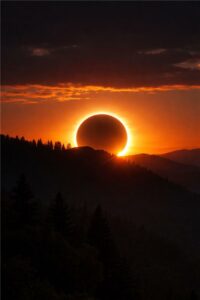
Unlike many images of past eclipses, where the Sun is high in the sky, the August eclipse will take place at dusk, reaching its peak at around 8.30 pm. This means we will see the Sun very low in the sky, and visibility will depend both on the weather and the surrounding landscape.
This vantage point, so close to the horizon, will make the view particularly beautiful, but also vulnerable. Any obstacle—a hill, a line of trees or distant buildings—could obstruct or even ruin the experience. We must therefore plan ahead to ensure that the chosen spot is truly the best one.
‘Mirror Day’: April’s dress rehearsal
Did you know that the Sun doesn’t set in the same place every day? Its path varies throughout the year, but there’s a simple way to find out exactly where it will be on 12 August.
Due to the symmetry surrounding the summer solstice, in the final days of April (29 and 30 April) the Sun follows a path almost identical to the one it will take on the day of the eclipse. This is what we call the ‘mirror day’: a perfect opportunity for a dress rehearsal, albeit without the eclipse.
What should we do these afternoons?
We invite you to make the most of these April afternoons to visit the spot from where you’d like to watch the eclipse and ask yourselves the following questions:
- Where exactly is the Sun hiding?
- Are there any obstacles on the horizon?
- Does the sun disappear behind a mountain before reaching the actual edge of the sky?
This exercise may seem trivial, but it will be the difference between enjoying the eclipse in its entirety or missing its final moments.
Did you know…?
During an eclipse when the Sun is so low in the sky, the atmosphere takes centre stage. The light has to pass through a thicker layer of air, which can cause the Sun to appear with more reddish or orange hues. Furthermore, atmospheric refraction can mean that the Sun remains visible for a few moments, even though it is already geometrically below the horizon, treating us to a truly special total eclipse.
Want to know more? The secret of the ‘mirror day’
If you’ve ever wondered why the Sun follows the same path on 29 April and 12 August, the key lies in its apparent position in the sky. Due to the Earth’s tilt, the Sun rises higher until the summer solstice and then begins to sink again. This means there are two dates — one before and one after the solstice — on which the Sun is at exactly the same height and sets in the same place.
However, there is a little trick for those who want absolute precision: clocks do not always keep time with the Sun. Since the Earth’s orbit is not a perfect circle, the Sun does not reach the same position at exactly the same minute every day.
Expert tip: If you want to carry out a trial run on 29 or 30 April, don’t look up at the sky at the exact time of the eclipse. Do it about 9 minutes beforehand. This small adjustment will allow you to predict exactly where the Sun will set on 12 August and ensure that no obstacles on the horizon prevent you from seeing the spectacle.
tags
- By Salvador J. Ribas
- ASTRONOMY
Documents
Links of interest
RELATED POSTS
-

- 21 July, 2026
Viewing the Solar eclipse safely: how to enjoy the phenomenon of the century without harming your eyesight
-
- 17 June, 2026
The solar corona: the ethereal mystery that will take center stage during the August 12 eclipse
-
- 22 May, 2026
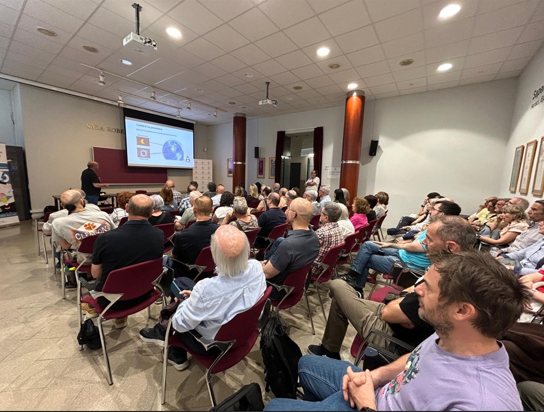
“The Day the Moon Will Hide the Sun”: Salvador J. Ribas brings the great eclipse to the University of Lleida
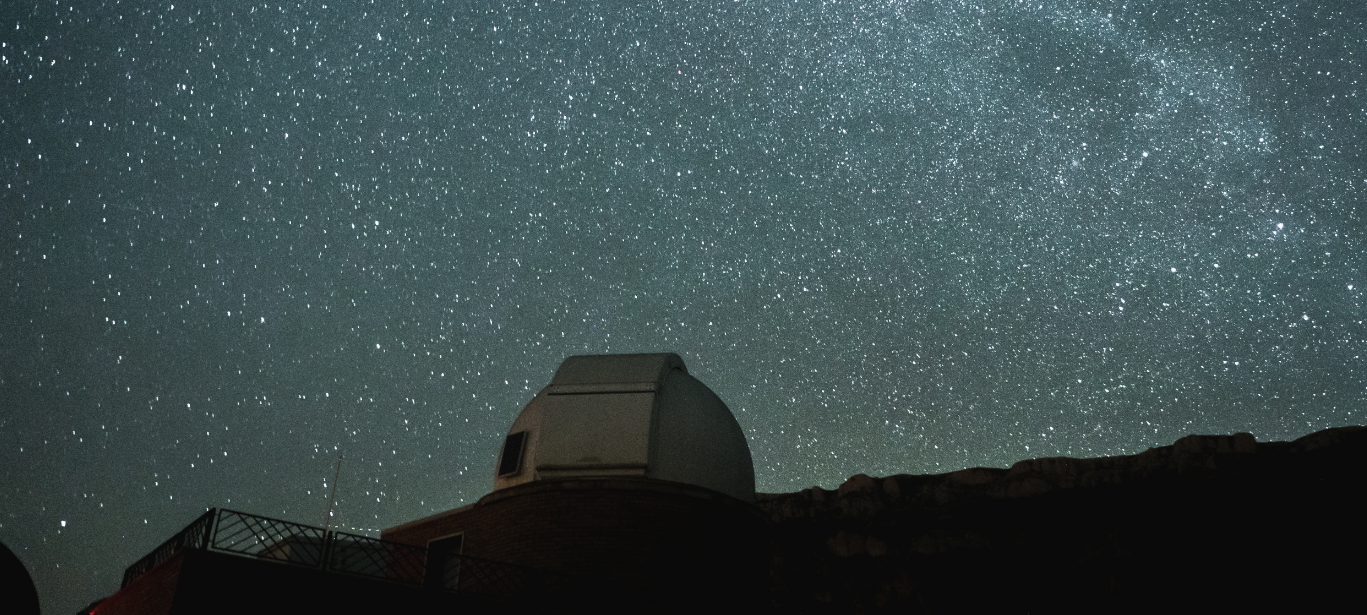
Did you know that the #SerradelMontsec is a declared space Reserve Starlight?
Sponsors











-
Dades predicció meteorològica:

-
Dades observació:

Dades de predicció
- Matí: Sol
- Tarda: Sol
- Màx: 32ºC
- Min: 15ºC
Dades observació
- No hi ha dades d'observacio disponibles
- Temperatura: 27.1ºC
- Humitat: 29%
- Vent: SSE 3.2 km/h
- UV: 0.0
- Radiació Solar: 241 W/m2

Infoparc
Tuesday 22, September 2026
EXPOSICIONS PERMANENTS
-
Sala
Univers -
Sala
Starlight
EXPOSICIONS
TEMPORALS
-
3CLIPSE