




- Experiences
-

- Experiences
-
- Experiences
-

- Experiences
-
- Experiences
-
- Experiences
-
- Unique Experiences
- Unique Experiences
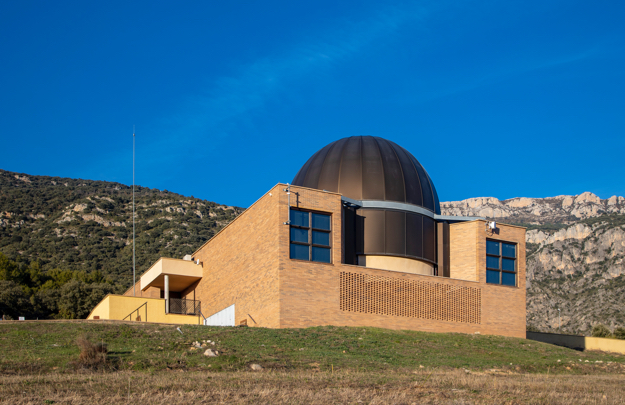

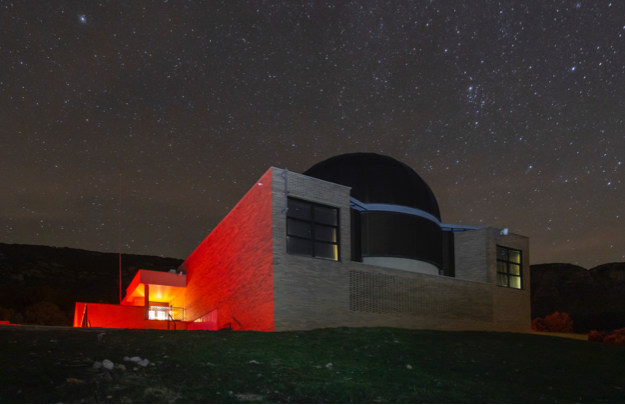
Camí del Coll d'Ares, s/n25691 Àger, Lleida
View on google mapsSegueix-nos
Enllaços als perfils del Parc Astronòmic a Facebook, X, Instagram i YouTube.

WHAT ARE YOU GOING TO SEARCH?
Total Solar Eclipse – August 12, 2026
At the Montsec Astronomical Park, we work every day to be an inclusive space where science and the discovery of the night sky are accessible to everyone. Our facilities feature a range of technical and architectural solutions designed to ensure the independence, comfort, and convenience of visitors with reduced mobility.What is a solar eclipse?

A total solar eclipse is an astronomical event in which the Moon comes to rest exactly between the Earth and the Sun, completely blocking the Sun for a few minutes.
At that moment, the sky darkens and day turns to night, giving way to a phenomenon as spectacular as it is rare: although there is a total solar eclipse somewhere in the world approximately every year and a half, the path where it is visible is so narrow that, from a single location on Earth, it can only be seen once every 350 years or so, although there may be fortunate places that enjoy two or more eclipses in much shorter periods.
In the case of Catalonia, the last total solar eclipse visible from anywhere in the region occurred on August 30, 1905. The next one, after 2026, will not occur until November 17, 2180, and after that, we will have to wait more than two and a half centuries for another opportunity: it will be in 2433. These facts highlight the significance of the eclipse on August 12, 2026.
Where will the solar eclipse be visible in Catalonia?
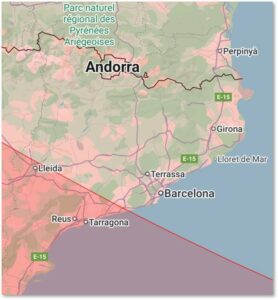
The path of totality will cross the southern third of our territory, passing through cities such as Tarragona and Lleida, which will enjoy a full view of the phenomenon.
The eclipse will occur at sunset, between 7:30 p.m. and 9:00 p.m., depending on the location. The totality phase—the most eagerly awaited moment—will last up to one and a half minutes in some areas of the southern regions of Tarragona.
What are the official observation points in Catalonia?
The Government, in collaboration with the municipalities located along the path of totality, has identified a number of sites that meet the safety and capacity criteria to serve as recommended viewing locations.
These are spacious areas that ensure safe access and mobility, offer good visibility, and prioritize the protection of the natural environment as well as logistical feasibility and essential services for large crowds.
The 20 towns are: Alcanar, L’Aldea, Altafulla, L’Ametlla de Mar, Amposta, Les Borges Blanques, Camarles, Cambrils, Constantí, Gandesa, Lleida, Montbrió del Camp, Móra la Nova, Reus, Salou, Santa Bárbara, Tarragona, Torredembarra, Valls and El Vendrell.
To learn more: https://eclipsicatalunya.cat/en/
The Astronomical Observatory team is present at several observation points
The Montsec Astronomical Park, as a leading center for astronomy outreach, will do everything in its power to ensure that the public can view the eclipse safely and with peace of mind.
Therefore, staff from the Astronomical will offer brief informational sessions to explain the phenomenon and how to view it safely. These sessions will take place at the beginning, during the partial phase, a few moments before totality, and a few moments after it has ended.
The Astronomical team will travel to the following locations:
- LLEIDA
- Observation site: the area around the Mangraners soccer field and Vila-Rodona Street is an unbeatable spot for viewing the eclipse: it’s an elevated location with no obstructions and the skyline of Lleida in the background.
- Reserve a spot: you can reserve a spot here
How can I watch the eclipse?
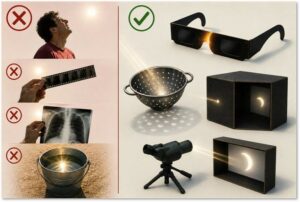
As spectacular as it may be, a total solar eclipse is a phenomenon that must be viewed with the utmost caution. Looking directly at the Sun without proper protection can cause serious and irreversible eye damage.
Only during totality can you look at the Sun without protection, and even then, you must take certain precautions to see details such as the solar corona or stars in the sky. Outside of this specific moment (which lasts between a few seconds and a minute and a half at most, depending on your location), you must always wear proper eye protection when looking at the Sun to avoid irreversible damage to your eyesight.
As for the observation techniques themselves, it is important to note that special eclipse glasses must comply with ISO 12312-2 and are intended solely for looking directly at the Sun. They must NOT be used if they are damaged or scratched.
When using telescopes, binoculars, or similar devices, it is essential to properly install the appropriate solar filters.
In addition to certified eclipse glasses, there are several methods of indirect observation that allow you to view an eclipse in complete safety. A pinhole camera, made from a simple cardboard box, projects the image of the Sun onto an internal screen without the need to look at it directly. The same principle can be replicated using perforated household items, such as a colander or even the shadows cast by tree leaves, which create dozens of small images of the eclipsed Sun. For more detailed observations, projection systems using telescopes or binoculars can also be used, always projecting the image onto a screen and never looking directly through the instrument. A very practical alternative is specialized equipment such as the Solarscope, a solar projector specifically designed for educational and outreach activities.
Future Eclipses
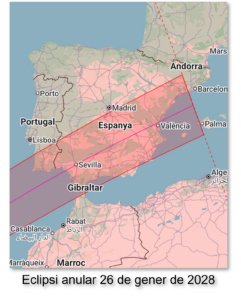
On March 29, 2025, there was a partial solar eclipse, which served as a prelude to the so-called “Iberian Triple.” In 2026, 2027, and 2028, the Iberian Peninsula will be the center of an unprecedented astronomical event: the observation of three consecutive solar eclipses over three years. Although solar eclipses are relatively common events worldwide, the fact that three will be visible from the same region within a short period of time is extraordinary.
In 2027, it will take place on August 2 and will be total in southern Andalusia and partial in Catalonia.
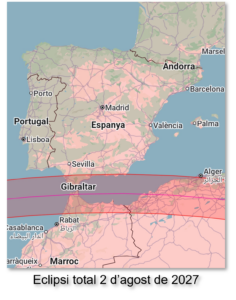
Meanwhile, in 2028, the eclipse will be annular and will be visible in southwestern Catalonia and as a partial eclipse in the rest of Catalonia on January 26.
Did you know that the #SerradelMontsec is a declared space Reserve Starlight?
Sponsors











-
Dades predicció meteorològica:

-
Dades observació:

Dades de predicció
- Matí: Calitja
- Tarda: Calitja
- Màx: 38ºC
- Min: 21ºC
Dades observació
- No hi ha dades d'observacio disponibles
- Temperatura: 30.9ºC
- Humitat: 28%
- Vent: SE 11.3 km/h
- UV: 4.2
- Radiació Solar: 698 W/m2

Infoparc
Monday 13, July 2026
EXPOSICIONS PERMANENTS
-
Sala
Univers -
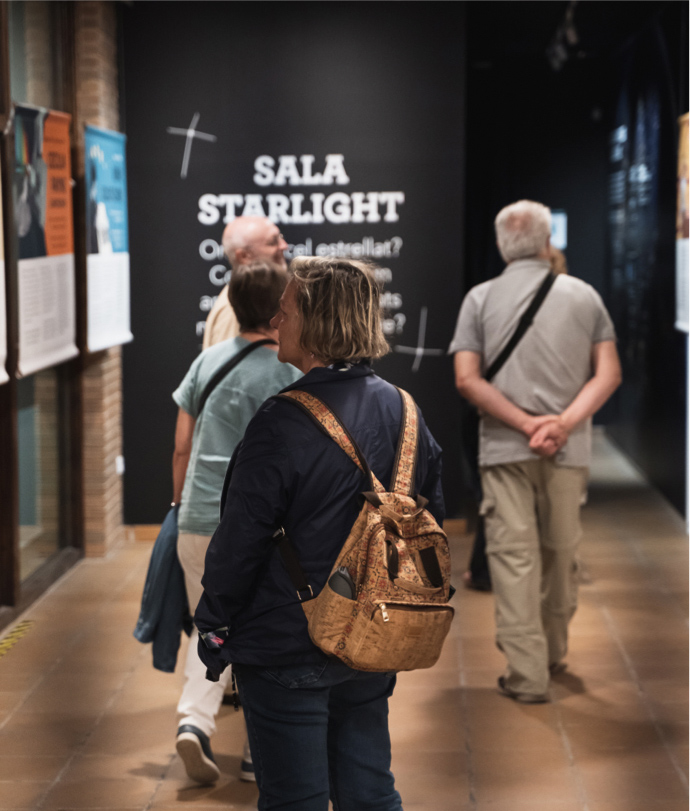
Sala
Starlight
EXPOSICIONS
TEMPORALS
-
3CLIPSE